The Pocket Brought the WonderSwan Back
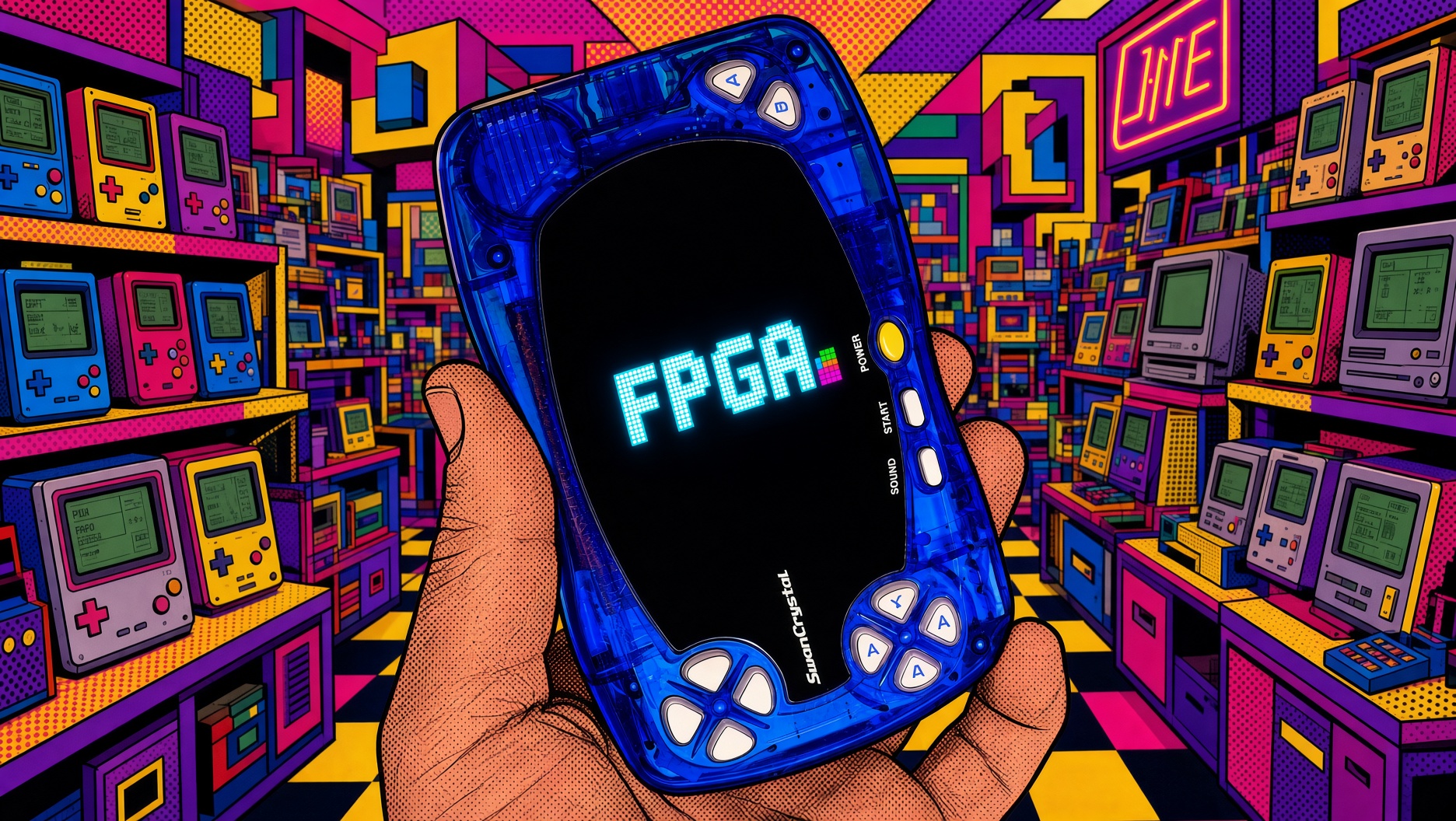
A traveling relative bought me a WonderSwan new. I was a kid. The box was Japanese. The manual was Japanese. The games were Japanese. Nobody at school had one. Everybody wanted to hold it.
That machine is why I own an Analogue Pocket. Adam Gastineau had ported a WonderSwan core to the Pocket’s openFPGA slot, built on work by FPGAzumSpass and the MiSTer WonderSwan core. I loaded it. I played the Swan again on a screen that does not look like a dying calculator. That is the whole review, if you only want one paragraph.
The rest is what the Pocket is, what the Swan was, and what that combination costs in money and fuss.
The kid with the weird handheld
Bandai shipped the WonderSwan in Japan in 1999. Gunpei Yokoi designed it after he left Nintendo. It was his last console. He died in a traffic accident in 1997. The Swan launched two years later as a cheap, light rival to the Game Boy: 16-bit CPU, one AA cell, about forty hours on the original monochrome set, a body you could hold in portrait or landscape. Color arrived in 2000. SwanCrystal arrived in 2002. Japan bought about 3.5 million. Bandai never sold it here.
Mine showed up because someone in the family crossed an ocean and thought a strange toy was a better gift than another Game Boy. I carried it like a secret and recess was a line of eager hands. Everybody wanted a turn. Then they handed it back and went to Pokémon on hardware their parents could buy at Walmart. I kept the Swan. I learned the two D-pads, the X cluster and the Y cluster, the way a title flipped when you turned the shell. I was the kid with the weird handheld. That was the fun.
Original units yellow. Caps wear. Screens fade. SwanCrystal FSTN panels were the good ones and they still die. I was not going to keep feeding a twenty-five-year-old Japanese portable a fresh AA and hope the ribbon cable held. I wanted the games and the layout. I did not want to nurse the plastic.
What the Pocket is
Analogue sells the Pocket as a premium Game Boy that happens to do more. Native slot: Game Boy, Game Boy Color, Game Boy Advance cartridges. Screen: 3.5-inch LTPS LCD, 1600×1440, about 615 pixels per inch, Gorilla Glass. That is ten times the original Game Boy pixel count on each axis. Battery: 4,300 mAh, USB-C, Analogue’s claim is six to ten hours. Ports: headphone jack, link, microSD. Optional dock for television and extra controllers. Street price has sat in the low two-hundreds since launch; adapters and the dock stack on top.
Inside: an Altera Cyclone V FPGA and a second Cyclone 10. Analogue programs those chips to behave like the original handheld silicon. Cartridge games run as hardware descriptions, not as a phone app guessing a Game Boy. Input lag stays low. Timing stays close. That is the reason to pay this much instead of buying a cheap Android slab with a ROM folder.
Official adapters cover Game Gear, Atari Lynx, Neo Geo Pocket / Color, and PC Engine / TurboGrafx-16 / SuperGrafx. Those are real cartridges in a real slot through a real mapper. openFPGA is the other door. A core author writes a description of another machine. You copy it to the SD card. The second FPGA loads it. WonderSwan lives there. So do a pile of other systems the official store never boxed.
Firmware 2.0, December 24, 2023, opened Original Display Modes and a CRT Trinitron filter to openFPGA cores, let cores change aspect when docked, and added APGB palettes for Game Boy. Later point releases fixed sleep, saves, and a list of specific titles. Update method: put the .bin on the card, boot, wait.
Build is matte plastic, vertical Game Boy proportions, four face buttons, a proper D-pad, two triggers. Buttons polish with use. That is plastic. The screen is the part that sells the device in the first five seconds.
The Swan core, in practice
Gastineau’s core is on GitHub: agg23/openfpga-wonderswan. Upstream is the MiSTer WonderSwan core by Robert Piep. Icon by spiritualized1997.
You supply BIOS. `bw.rom` for the original Swan. `color.rom` for Color and Crystal. Both go in `/Assets/wonderswan/common/` with the ROMs. MD5s are published on the repo. No BIOS, no boot.
Features that matter on a commute:
- Memories. Save states. Sleep plus wake. Tap power, pocket it, resume.
- Fast forward at 2.5× on the minus button. Tap to lock.
- Horizontal and vertical maps, because the Swan was two layouts in one shell.
Horizontal: Pocket D-pad to Swan X; A to A; B to B; X to Y3; Y to Y4; L to Y1; R to Y2; plus to Start.
Vertical: Pocket D-pad to Swan Y; A to X3; B to X4; X to X2; Y to X1; L to A; R to B; plus to Start.
That is as close as a Game Boy-shaped brick gets to Yokoi’s dual-pad idea. It is not the original shell in your palm. Vertical mode on the Pocket lines up better than you expect. Horizontal still asks your thumbs to learn a new neighborhood. I play vertical first. The old recess memory is portrait anyway.
Color games look finished on this panel. The Crystal was already the Swan’s best screen. The Pocket is a different class of sharpness. Fast forward is the cheat I did not have as a kid and will not give back. Sleep/wake is how a grown man finishes a dungeon in a parking lot.
What you do not get: an official Bandai adapter that eats real Swan carts in the Pocket slot. This core is files on a card. If you still own the Japanese cartridges, you dump them or you keep a real Swan alive for that sweet sweet nostalgia hit.
The rest of the library
I bought the Pocket for Game Boy and stayed for everything else. GBA fills the screen with bars and still looks better than an SP under a book light. Game Gear through the adapter is the first time that system has looked like a real product.
openFPGA is a second hobby. Cores vary. Some are daily drivers. Some are science projects. The WonderSwan core is a daily driver. That is the sentence I needed in 2023.
Docked play works if you want a television. I rarely dock. The point of this machine is the same point as the Swan: it fits in a hand and does not need a living room.
What I pay for and what I will not romanticize
The Pocket is expensive for a device that still wants you to own cartridges or dumps and, for the Swan, two BIOS files. Analogue’s stock and colorways have been a mess since the first preorder. Adapters are extra money. openFPGA is community work. Analogue did not ship me WonderSwan. Gastineau did.
Battery is fine but not forty hours on one AA. The Swan won that contest and always will.
Controls on a dual-pad system will never be perfect on a Game Boy face. Anyone who says otherwise skipped vertical Rockman. I mapped, I practiced, I play.
Why this system is in my go bag
I was the kid with the handheld nobody sold at the mall. Other kids lined up because it looked like a toy from a future.
I niwnhave the complete library and can charge with the same cable as my phone. I boot the core. I pick a title. The Pocket is a Game Boy done at a price you'd expect for a kid's handheld fantasy system