The Pontiac Aztek: The Future Taken For Granted
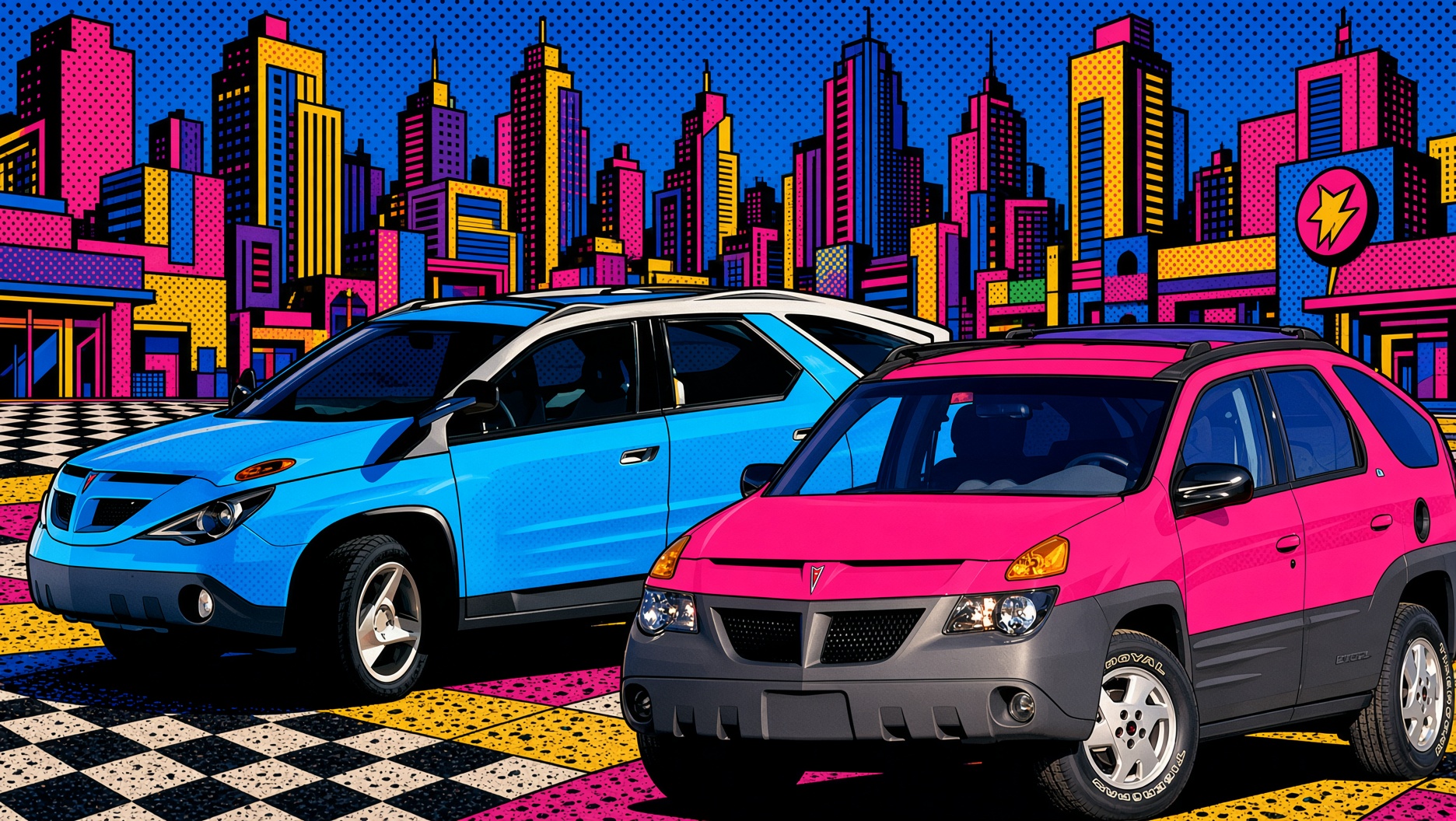
The Pontiac Aztek was ugly.. It looked like a minivan that had been recruited to fight for the Rebels in Star Wars. Walter White drove one. Countless Internet lists put it at the top of the worst-cars of all times. All of that is true enough from a consumer standpoint, It is not true as engineering history.
The Aztek was a California idea about how a young household should live out of a vehicle. It arrived too early, on the wrong platform, with a face GM would not redesign. The features that got laughed at in 2001 are now catalog items on vehicles that sell by the hundreds of thousands. The people who drew it did not disappear. One of them went on to shape three generations of Corvette. Another left Detroit and has spent a quarter century teaching designers in Cincinnati.
Bear Claw
In the mid-1990s Tom Peters was running GM’s West Coast Advanced Concept Center in Thousand Oaks. The brief from Detroit was not “make a pretty Pontiac.” Rick Wagoner’s shop had decided that 40 percent of new product had to be innovative, which in a company that had spent a decade being called timid was an order to take a swing.
Peters put the problem to the room the way a shop guy would: what if you dropped a Camaro and a Blazer into a blender? The sketch that came back was called Bear Claw. Brigid O’Kane, a senior lead creative designer on the West Coast staff, signed the early drawings. The first version sat on an S-series full-frame chassis. Wide track. Low roof. Flared arches. Four-wheel drive. Off-road rubber.
Peters later said they wanted “a bold, in-your-face vehicle that wasn’t for everybody.” Pontiac was still the excitement division. The intended customer was Generation X, California-adjacent, more likely to sleep at a trailhead than valet at a country club.
The 1999 Detroit concept was received well. It was not the Bear Claw, but it still had the stance. Contrast paint in the window openings. Better wheels. A nose people could live with. Pontiac billed it as a Sports Recreational Vehicle. The press, for a short window, gave much attention to GM for the bold design move. Then they designed it around the U Platform.
The platform that altered the plan
The production Aztek, sold for the 2001 through 2005 model years and built at Ramos Arizpe in Mexico, rode the same front-drive minivan architecture as the Pontiac Montana. Related vehicle: the Buick Rendezvous.
That one decision rewrote the proportions. Cowl up. Roof up. Body narrowed. Dash-to-axle shoved forward. Wheel arches shrunk to fit minivan tires. Plastic cladding went on because someone in the chain decided a lifestyle truck needed armor, and then more armor, and then a committee to approve the armor. Peters has been consistent about this for years: the original intent did not survive the platform change. The production car is what you get when a low, wide off-road hatch is forced onto a tall, narrow people-mover.
Bob Lutz, who was not even at GM when the clay was locked, later described the culture that approved it as complete acquiescence. Focus groups hated it. The quote that stuck was that people would not take one as a gift. Management had already decided it would astound the world. Negative comments were not welcome.
What it actually was
Five doors. Front-wheel drive standard. Versatrak all-wheel drive optional. For all it's flaws it still had a shot.
Versatrak is the part the lists skip. It was not a viscous coupler pretending to be a transfer case. Steyr-Daimler-Puch built it under license from McLaren Traction Technologies. Hydraulic gerotor pumps and multi-plate clutches sent torque aft when the fronts slipped. All-wheel-drive Azteks got an independent rear suspension with aluminum control arms and a crossmember, plus rear disc brakes. Front-drive trucks kept the beam axle and drums. If you were going to own one in Indiana, the AWD car was the one that made sense on a January morning on Ind. 37 or a wet ramp off I-69.
The engine never changed. GM’s 3.4-liter LA1 60-degree V6, overhead valves, twelve of them, sequential multiport injection. 185 horsepower at 5,200 rpm. 210 pound-feet at 4,000. The only gearbox was the 4T65-E four-speed automatic. Tow rating with the package was 3,500 pounds. EPA numbers sat in the high teens city, mid-20s highway, depending on year and drive. It was the Montana’s motor in a shorter, angrier box. Nobody bought an Aztek to win a drag strip. They bought it to leave on Friday and come back Sunday with wet boots.
Cargo with the rear seats out was about 93.5 cubic feet. A four-by-eight sheet of plywood would lie down. The seats themselves unlatched and came out. That is minivan thinking applied to a vehicle Pontiac was trying to sell as an adventure tool, and it was the right thinking.
The HUD, and why it mattered
General Motors put the first production automotive head-up display in a 1988 Oldsmobile Cutlass Supreme Indianapolis 500 pace car. Hughes Aircraft and Delco Electronics did the work after GM bought Hughes in 1985. The idea was fighter-jet glass in a family coupe: speed, a few telltales, projected onto the windshield so the driver did not have to drop his eyes to the cluster.
Pontiac already knew the hardware. Grand Prix and Bonneville carried HUD in the early 1990s. The C5 Corvette got a more serious color unit at the end of that decade. BMW did not offer a production HUD until 2003. Most crossovers did not bother for another ten years.
The Aztek put that same GM HUD in a camping wagon aimed at people who were supposed to be looking at the road, not the radio. On the GT and in the later Luxury Appointment Group it was a real option. On the 2004 Limited it was standard. The image sat out toward the bumper line. Speed stayed up constantly. Radio station, CD track, or tape showed for three seconds after a change. Turn signals, high beams, low fuel, and a “check gages” prompt came up when they had something to say. Brightness auto-dimmed off a photocell. A switch next to the cluster moved the image up and down.
It was not a toy. It was cockpit logic in a vehicle the market had decided was a clown car. Twenty-five years later the same feature is a checkbox on a loaded Traverse, a Palisade, a Grand Cherokee, a Telluride.
The rest of the kit people now pay extra for
Pontiac’s own line was “quite possibly the most versatile vehicle on the planet.”
The center console was an insulated cooler. It unlatched, took a handle, and walked to the picnic table with a dozen cans in it. The rear cargo tray rolled out on wheels and was rated to 400 pounds. An optional air compressor lived in back for mattresses, bike tires, and the official Aztek air bed. Cargo nets anchored to the floor in more configurations than anyone used. Seat-back packs came out and became backpacks. The tailgate was a split: glass up, gate down, cupholders in the gate so you could sit on your own bumper. The camping package added a branded tent that sleeved over the open rear and turned the cargo bay into a two-person shelter. Fold the seats, drop the mattress, zip the fly.
Later years added the things every family truck now assumes: overhead DVD with a seven-inch screen and wireless headphones, XM, a tire-pressure monitor, MP3 in the dash, OnStar that you could talk to without finding a button. None of that was magic. The combination, in 2001, was.
J.D. Power named it Most Appealing Entry Sport Utility Vehicle in 2001. Owners liked the package. They did not like the face. That split — useful inside, radioactive outside — is the entire commercial story.
GT, Rally, Limited
The Early GT was the one to have. Traction control on front-drive trucks. Optional Versatrak. Dual-zone air. Overhead console. Better seats. The HUD lived here first. A 2001 GT AWD stickered in the mid-20s before the options printer got warm. As-tested numbers in period reviews sat around $25,000, which was a lot of money for a buyer Pontiac had described as young.
After 2001 the GT name receded and the company started cutting price to move metal. The interesting hardware migrated into packages.
The Rally Edition, late 2003 into 2004, was the closest the production car came to looking like it meant it. Lowered front suspension. Seventeen-inch chrome-finished aluminum wheels on 225/60R17 rubber. Body-color grille instead of the chrome grin. Chrome exhaust tip. Rally badges. Embroidered mats. Dark gray interior. Colors were the point: Black, Fusion Orange Metallic, Liquid Gray Metallic. Leather with Rally embroidery was on the sheet if you paid for the Luxury Appointment Group.
Limited, 2004, was the quiet premium car. Leather, better stereo, rear spoiler, aluminum interior trim, six-way driver’s seat, HUD in the standard column. That is the one that feels like someone in Pontiac still believed the original customer existed.
Under all of them: same 3.4, same four-speed, same choice of front-drive or Versatrak. The premium lines did not get a different motor. They got the features the concept had promised.
The designers
Tom Peters did not get fired. He went back to the work he was built for.
He had already been inside Corvette studios under Jerry Palmer. After Aztek he became the exterior lead on the C6 Corvette, then the C7 Stingray, and he saw the mid-engine C8 off the board before he retired in 2019. The fifth-generation Camaro is his. He took a lifetime achievement award from Art Center, his school. The National Corvette Museum put him in the Hall of Fame the year he left GM and later hired him as consulting curator of exhibits. The man who signed the most-mocked crossover of the decade spent the rest of his career making America’s sports car look like it wanted to fight. The two facts can sit in the same paragraph. Designers are not their worst committee.
Brigid O’Kane left GM around 2000 on a sabbatical the company gave her and did not go back. She taught at Art Center briefly, did some film-set work in California, then took a faculty post at the University of Cincinnati’s College of Design, Architecture, Art, and Planning. She is still there. She co-founded Manifest Creative Research Gallery and Drawing Center in Cincinnati in 2005. DesignIntelligence named her one of the thirty most admired educators in 2014. She has said, without bitterness, that her Aztek design was chosen for production and that what came out was a little different. That is the polite version of the U-body story.
Mark Reuss, the vehicle line executive on the program, later became president of General Motors. The Aztek did not end careers. It ended a brand’s patience for looking strange on purpose.
What would wear the jacket now
There is no Pontiac. There is no second Aztek. The Torrent that replaced it in 2006 was an Equinox in disguise.
The spiritual successor is not a styling clone. It is a vehicle that still tries to be a Camaro and a Blazer in the same body, will let you sleep in it, and does not apologize for looking like it has a job.
GM thought it would sell 75,000 a year and needed about 30,000 to break even. Best calendar year was 2002: 27,793. The run in the United States looks like this: 11,201 in the short 2000 launch year, then 27,322, 27,793, 27,354, 20,588, and 5,020 in 2005 while the plant wound down. A few hundred leftovers dribbled into 2006 and 2007. Call it 120,000 copies, give or take the Mexican tally. Pontiac was gone four years later.
That is a miss. It is not a mystery. The concept was the product people would have paid for. The production car was a minivan in a Halloween mask, priced above the Honda and Toyota crossovers that already existed, aimed at a buyer who was a bit more astute than care buyers before them.
Owners who kept them got a useful truck with a cockpit display most luxury brands had not bothered to fit, a cooler that was a console, and a tailgate ready for work or play. The market punished the Pontiac line and ended up keeping most of the innovations for other brands.
The future the Aztek was pointing at showed up anyway. It just showed up in vehicles people were willing to be seen in. That is not the same as saying the Aztek was beautiful. It is saying the brief was right, the platform was wrong.